Architecture & limits
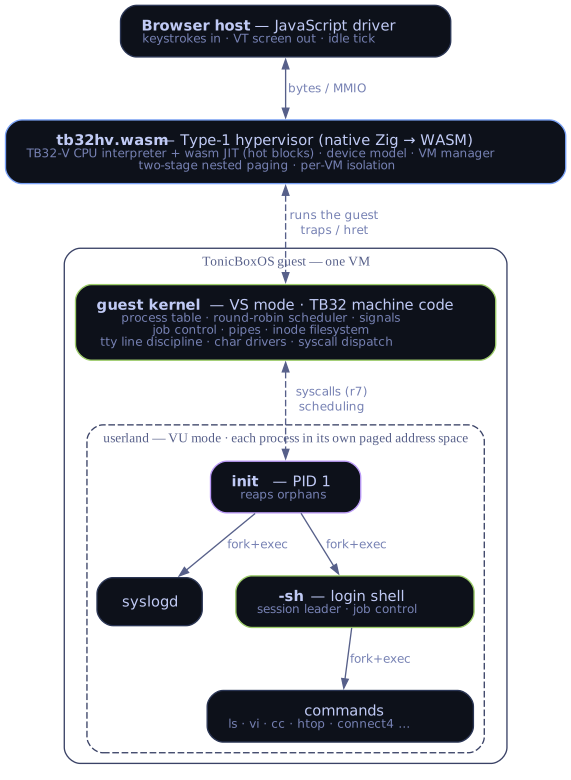
A complete operating system that runs in a browser tab. A Type-1 hypervisor (tb32hv), compiled to WebAssembly, hosts a single guest: TonicBoxOS. The guest's kernel and userland are both machine code for a custom 32-bit ISA (TB32), executed by the hypervisor's CPU. The kernel runs de-privileged in guest-supervisor mode; userland reaches it only across a system-call boundary.
00The stack
Four layers. Only the top one is native code; everything below it is TB32 machine code the CPU executes:
| Layer | What it is |
|---|---|
| host | a JavaScript shim: feeds input, paints an output buffer to the screen, and ticks the hypervisor while idle |
| hypervisor | tb32hv.wasm, native WebAssembly: the TB32-V CPU that interprets the guest - with a WebAssembly JIT that compiles hot code blocks at runtime - the device model (console, block device, RTC, RNG), and a small VM manager. It runs one guest, isolated by two-stage nested paging |
| guest kernel | TB32 machine code, run in guest-supervisor (VS) mode: scheduler, process table, signals, filesystem, drivers, syscall dispatch |
| userland | TB32 machine code, run in guest-user (VU) mode; each process in its own isolated paged address space |
Userland enters the kernel only through a SYS instruction, with the call number in
r7: the CPU takes a trap and hands it to the guest kernel. Each process has its own
page table, so address spaces are isolated - there is no shared memory and no virtual address that
reaches another process or the kernel. Pages are allocated on first touch (demand-zero) from a
physical frame pool, and fork shares them copy-on-write. A second translation stage
(guest-physical to host-physical) walls the whole VM off from the host, the same way the
tb32hv hypervisor isolates any guest.
01Processes
fork copies a process copy-on-write into a fresh address space; exec replaces the image in place;
wait reaps children. Scheduling is preemptive round-robin: a hardware
timer preempts each runnable process after a fixed instruction quantum, so daemons and background jobs
advance while the shell waits at a prompt.
Boot enters init as PID 1: it spawns the services and, on the
interactive console, a getty-style login that authenticates against /etc/shadow
and drops privileges to your login shell (the system is multi-user - root, tonicbox,
dev - with euid-enforced permissions). init then reaps orphans for the rest of the session. Signals are complete: handlers, masks, default actions,
and job control. PID 1 ignores any signal for which it has no handler installed, so userland cannot
terminate it.
Processes talk over real pipes, and the console has an in-kernel termios line
discipline (cooked/raw modes, echo, editing). The shell is a session leader
that puts each job in its own process group and hands the terminal to the foreground job, so
Ctrl‑C, Ctrl‑Z, and fg/bg behave the way
they do on a real Unix.
| Piece | What it is |
|---|---|
init | PID 1; spawns services + the login shell, reaps orphans |
syslogd | a daemon draining the kernel log to /var/log/messages |
| scheduler | preemptive round-robin over a pool of process slots |
| signals | kill, handlers, pause, job control |
02Kernel & VFS
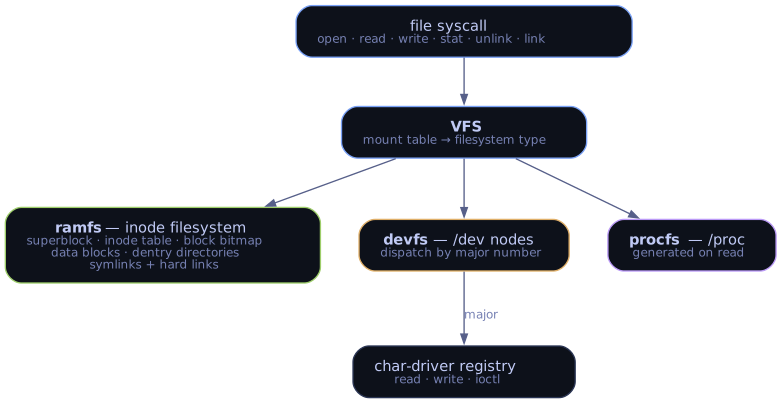
A monolithic VFS, Linux-style: a mount table routes each path to a filesystem type, and file operations dispatch from there.
- ramfs: a real inode filesystem - a superblock, an inode table, a data-block bitmap, and data blocks, with directories stored as dentry blocks. It supports symbolic and hard links.
- devfs:
/devnodes carry a device number and dispatch through an in-kernel char-driver registry, keyed by major number, that exposesread/write/ioctl. - procfs:
/procentries generated on read.
03Toolchain
Self-hosting. TBC (a C subset) compiles to TB32 assembly, and the assembler emits a TBX executable the kernel loads. The compiler and assembler are themselves TB32 programs that run inside the OS, so building and debugging happen entirely in the terminal.
04Limits
Structures are fixed-size and in-memory. The main limits:
| Area | Limit |
|---|---|
| processes | a fixed pool of process slots; beyond it, spawns are refused rather than queued |
| memory | each process has its own paged virtual address space (4 KiB pages, demand-zero, copy-on-write fork, mmap/mprotect); pages are backed by a shared physical frame pool, so total live memory across all processes is bounded by the pool |
| filesystem | an inode/block filesystem on a virtual block device, with a fixed inode count and a fixed number of data blocks; state is per-session (reset on reload, or saved to the browser) |
| arguments | a command takes a bounded number of arguments |
| streams | a pipe is a bounded ring buffer; a full pipe blocks the writer until the reader drains it, so large streams flow through without loss |
| compiler | TBC is a subset: no floats or structs. It does have enums, typedef, multidimensional arrays with brace initializers, a #if/macro preprocessor, and a malloc/mem*/str* prelude; function pointers are supported (untyped) |
| shell | functions are scoped to a single command line and do not persist across prompts |